
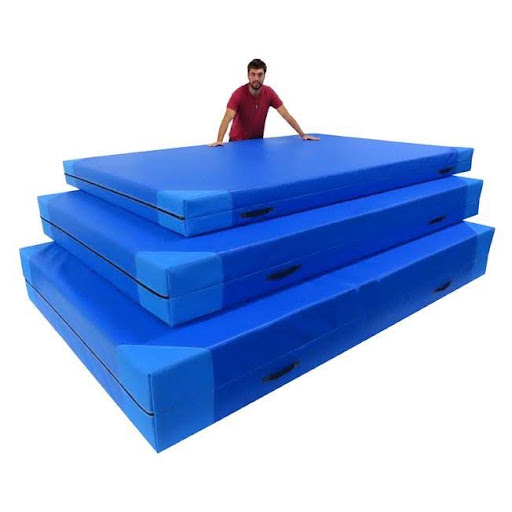
The first attempt at a handspring often ends somewhere other than the planned landing point. Beginner gymnasts are still learning body control, timing and confidence, so a school must prepare for imperfect movement rather than assume every skill finishes neatly. A safer landing zone combines suitable equipment, clear space, close supervision and teaching that matches the learner’s stage.
Start with the activity, not the available cupboard. Forward rolls, jumps, balances and supported inversions create different landing patterns. Teachers should identify where a pupil is expected to finish, where an error could carry them, and which nearby objects increase the consequence of a fall. That wider area matters because beginners frequently step, roll or stumble beyond the centre of a station. The safest boundary is based on likely error, not the neat line shown in a lesson diagram.
Crash mats provide extra impact absorption for selected activities, but they are not a substitute for sound instruction or active spotting. Their thickness, firmness and size should suit the intended skill and the age of the pupils. A very soft surface may feel reassuring yet make stable landings difficult, while an unsuitable hard surface may not reduce impact enough. Equipment should be chosen for its defined purpose. Labels and supplier guidance should remain available so staff do not rely on memory or appearance.
Placement demands care. Mats should lie flat, with no curled edges, large gaps or unexpected changes in height. Where several pieces meet, the joins should not sit directly beneath the likely landing point. Teachers also need to consider whether a pupil could slide off the surface or land partly on and partly off it. Non-slip bases and a clean, dry floor support stability.
A quick inspection before every lesson catches common problems. Staff should look for damaged covers, exposed foam, compressed areas, loose fastenings and contamination. Crash mats that have shifted during an earlier activity need resetting before the next pupil begins. Any item that no longer performs as intended should be removed from use and assessed through the school’s normal equipment process.
Teaching order shapes safety as strongly as the landing surface. Pupils first need the basic body positions, strength and awareness that support the full skill. Breaking a movement into smaller parts allows the teacher to observe control before increasing difficulty. Progression should follow demonstrated readiness, not pressure to keep every pupil on the same timetable.
Supervision should match the station. The teacher needs a clear view, a manageable group size and enough time between attempts to give useful feedback. Pupils waiting nearby should know where to stand and when to move. Peer assistance must only be used where it is appropriate, taught and supervised, since untrained help may introduce a new risk.
Storage also affects future condition. Folding, dragging or stacking equipment incorrectly may damage internal foam or covers. Mats should be kept in a dry area away from sharp objects and heat sources, following the maker’s handling guidance. A simple check-in routine helps staff notice damage before equipment returns to the hall.
Schools should record their planned activities, equipment choices and inspection arrangements as part of their wider safety approach. Requirements differ between settings, age groups and programmes, so local policies and qualified guidance remain important. No single layout suits every class.
A well-designed landing zone makes errors less serious without hiding the need for careful teaching. Appropriate space, stable surfaces and controlled progression work together. Used for the right activities and checked consistently, crash mats form one practical layer in a broader system that helps beginners learn with confidence.