
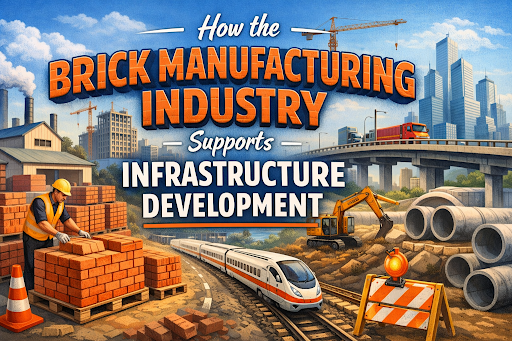
In various towns, robust walls and roads are an essential part of life and economic development. The development of homes and other structures depends on the availability of building materials. Within this context, the brick manufacturing industry in India is playing a steady role by providing robust bricks to help developers and planners work together to develop modern infrastructure.
- Bricks as the Foundation of Growing Cities: The bricks provide the basic blocks for the construction of homes, offices, hospitals, and transport structures in the growing regions. This is because bricks have a uniform size, strength, and thermal balance. They provide engineers with the ability to design safe structures for the busy urban centres. Brick production guarantees the availability of bricks for the construction of large and small structures in towns, villages, and industrial areas for the development of structured urban expansion and development.
- Supporting Urban Development: There are reliable sources of construction materials that are provided by brick production centres located in regions rich in clay deposits. The centres provide affordable bricks that are essential for homes, halls, schools, and health centres. The availability of the bricks ensures the development of village infrastructure, thus providing employment opportunities that boost regional development.
- Strengthening Road and Public Works Projects: Public works projects such as drainage systems, pavement construction, boundary walls, and public utility buildings require bricks due to their long-lasting and easy building qualities. The government infrastructure development projects often involve brick masonry in the development of pathways, bus stops, storage facilities, and service centres. The availability of bricks is essential in the completion of development projects in various cities, towns, and growth corridors nationwide.
- Encouraging Local Employment and Skills: Brick manufacturing clusters provide large employment opportunities to workers, artisans, transporters, and equipment operators. Shaping, drying, and kiln management operations require skilful labour and provide jobs to thousands of workers. These jobs help workers develop skills such as teamwork and steady income flows. The labour force’s high participation is beneficial to regional development and infrastructure expansion due to increasing construction needs in various states.
- Affordable Housing Growth: Such programs need cost-effective materials in order to ensure the construction of strong homes. Brick construction meets these conditions by providing a balance of strength and affordability. Families, builders, and affordable housing programs can use bricks to ensure the construction of comfortable homes. States have large housing missions that use bricks to construct walls and foundations of homes. This has helped cities grow to accommodate many families.
- Driving Infrastructure for Future Cities: Future-ready cities need reliable building materials for their transit systems, schools, hospitals, homes, and commercial centres. Bricks are an essential component of such cities that engineers know they can depend upon. The stability and flexibility of brick structures are highly prized and help in long-term urban infrastructure development while allowing cities and towns in India to grow around well-planned transport systems, schools, hospitals, and thriving commercial centres.
In conclusion, the progress of infrastructure development in the country is still moving forward, with robust materials being used in all the infrastructural developments. From residential colonies to public infrastructures, the significance of the brick making company is still substantial in contributing towards the availability of bricks to aid in the infrastructural developments. This is contributing towards the growth of infrastructural developments in the country with vibrant progress every year.