
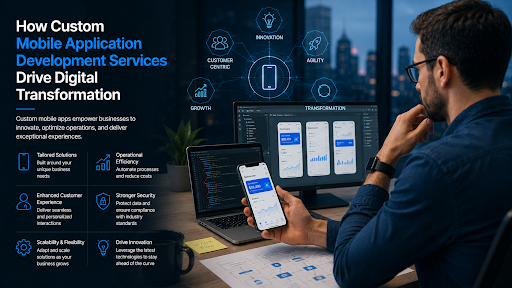
A regional logistics company I read about was running its entire dispatch operation through a mix of phone calls, a shared spreadsheet, and a generic scheduling app that wasn’t built for trucking at all. Drivers missed updates. Dispatchers duplicated work. Nobody had real visibility into where anything actually was on a given afternoon. They weren’t behind on technology in some abstract sense. They were behind because none of their tools were actually built for how their business runs.
That’s the quiet reality behind a lot of “digital transformation” conversations. It’s rarely about a company refusing to adopt new tools. It’s about companies adopting generic tools that almost fit, and living with the friction of “almost” for years because nobody stopped to ask whether something custom-built would actually solve the problem. Good mobile application development services exist precisely to close that gap, and the businesses doing this well are seeing transformation that’s measurable, not just a buzzword on a slide deck.
Here’s what that actually looks like in practice, and why off-the-shelf software keeps falling short for businesses with real operational complexity.
Why Off-the-Shelf Software Hits a Ceiling
Generic software gets built for the widest possible audience, which means it’s optimized for nobody’s actual workflow in particular. It handles the common eighty percent of use cases reasonably well and leaves businesses improvising workarounds for the twenty percent that makes their operation genuinely different from everyone else using the same tool.
That twenty percent matters more than it sounds like it should. It’s the specific approval chain a manufacturing business needs that a generic project management tool doesn’t support. It’s the unusual inventory categorization a specialty retailer relies on that a standard point-of-sale system can’t accommodate without painful manual workarounds. Individually these gaps look minor. Across a year of daily operations, they compound into a genuinely significant drag on efficiency that rarely gets attributed to its actual cause, the software, because everyone’s just used to working around it.
What Custom Development Actually Solves That Generic Tools Can’t
Custom mobile application development starts from the opposite direction entirely. Instead of asking a business to adapt its operations to fit existing software, it builds software around how the business genuinely operates, including the quirks and exceptions that make that business different from its competitors.
This matters most for businesses with workflows that are either highly specialized or that represent a genuine competitive advantage worth protecting. A field service company with a unique scheduling logic that accounts for technician skill levels, parts availability, and geographic clustering isn’t going to find that logic baked into a generic scheduling app. A healthcare provider with a specific patient intake process shaped by years of refinement isn’t going to want to flatten that process down to whatever a generic EHR-adjacent app happens to support.
Custom development also solves an integration problem that generic tools handle poorly. Most businesses run several systems already, accounting software, inventory management, customer relationship tools, and a custom app can be built specifically to talk cleanly to all of them, rather than forcing yet another disconnected tool into an already fragmented tech stack.
Real Operational Impact, Not Just a Nicer Interface
The logistics example from earlier isn’t hypothetical in spirit, even if the specifics are illustrative. Companies that move from generic tools to purpose-built mobile apps consistently report a few recurring outcomes worth naming specifically.
Faster decision-making, because real-time data actually reaches the people who need it rather than getting trapped in a spreadsheet someone updates twice a day. Fewer errors, because a workflow built around how work actually happens leaves less room for the manual re-entry and miscommunication that generic tools tend to create. Better employee experience, because frontline staff using a tool genuinely built for their actual job tend to adopt it faster and resist it less than staff handed something that almost fits but clearly wasn’t designed with their specific role in mind.
There’s also a data quality benefit that’s easy to underestimate going in. Custom apps can be built to capture exactly the data a business actually needs for decision-making, structured the way that business actually thinks about its own operations, rather than whatever fields a generic tool happened to include for its broadest possible customer base.
Where Digital Transformation Actually Stalls Without Custom Tools
A lot of digital transformation initiatives stall not because leadership lacked ambition, but because the tools chosen to execute that ambition weren’t actually capable of supporting it. A company rolls out a new generic platform, gets excited about the launch, and then spends the next year fighting the same workarounds and friction that existed before, just inside a slightly different interface.
This is where custom mobile development genuinely changes the trajectory. Instead of transformation being a one-time platform switch, it becomes an ongoing capability, a tool that can actually evolve as the business evolves, rather than locking a company into whatever roadmap a generic software vendor decides to prioritize for its broader customer base. Businesses with custom tools can add a feature the moment a real operational need emerges, rather than submitting a feature request to a vendor and waiting, sometimes indefinitely, for it to land on someone else’s product roadmap.
What Businesses Should Actually Look For in a Development Partner
Real transformation through custom mobile development depends heavily on the development partner actually understanding the business first, before writing any code. A team that jumps straight into wireframes without genuinely understanding the operational reality they’re building for tends to produce something that looks custom but functions almost as generically as the tool it replaced.
The stronger signal is a partner who asks detailed questions about actual workflow, actual exceptions, actual pain points that current tools create, before proposing a single feature. A partner who treats discovery as a real phase rather than a formality tends to build something that genuinely fits, rather than something that looks impressive in a demo but quietly reintroduces the same friction it was meant to eliminate.
Long-term thinking matters here too. A custom app isn’t a one-time build, it’s infrastructure that needs to evolve as the business grows and changes. While many best AI tools for small businesses can improve productivity and automate everyday tasks, they often have limitations as your business scales. A development partner thinking beyond launch, rather than just the initial release, builds solutions that evolve with your business instead of creating technical debt that leads to tomorrow’s challenges.
The Bigger Picture
Digital transformation gets talked about as though it’s primarily about adopting new technology. The more accurate framing is that it’s about closing the gap between how a business actually operates and what its tools genuinely allow it to do efficiently. Generic software narrows that gap partway. Custom mobile development closes it specifically, for the exact operational reality of one particular business rather than the broadest possible audience a generic tool was built to serve.
The businesses seeing real transformation, measurable efficiency gains, fewer errors, better adoption from their own teams, aren’t necessarily the ones spending the most on technology. They’re the ones who recognized early that their operations were specific enough to deserve software built specifically for them, rather than software they’d spend years quietly working around.