
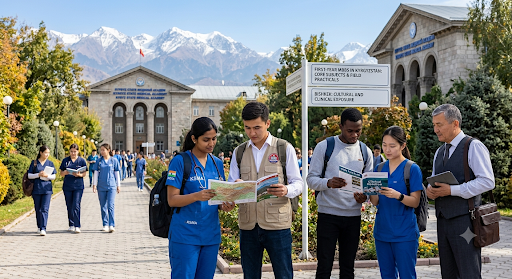
Kyrgyzstan has been one of the most consistently popular destinations for Indian medical students over the past two decades. Affordable fees, English-medium instruction, NMC recognition, and a large established Indian student community have all contributed to this popularity. However, 2026 has brought a significant regulatory shift that has fundamentally changed the medical education landscape in the country. Any student or family currently evaluating MBBS in Kyrgyzstan must understand what has changed, which institutions are affected, and how to make a sound decision in this new environment.
Why Indian Students Choose Kyrgyzstan
The primary draw has always been cost. Annual tuition fees at Kyrgyz medical universities have historically ranged from approximately USD 2,500 to USD 4,500 per year, making it one of the most affordable MBBS-abroad destinations globally for Indian students. Total all-inclusive six-year costs — covering tuition, hostel, food, and living expenses — have typically ranged from Rs. 15 lakh to Rs. 35 lakh depending on the university and lifestyle, compared to Rs. 80 lakh or more at many Indian private medical colleges.
English-medium instruction is standard across recognised universities, removing the language barrier that affects many other countries. More than 15,000 Indian students are currently enrolled across Kyrgyz medical institutions, creating a large, supportive peer community particularly in the capital city, Bishkek. Most top universities are NMC-recognised and listed in the World Directory of Medical Schools, which are the two baseline requirements for Indian graduates to remain eligible to sit for India’s licensing examination after graduation.
The University Landscape Before 2026
Kyrgyzstan currently has 34 institutions training medical personnel — 12 public and 22 private. This number grew rapidly over the past decade as low barriers to entry allowed private institutions to proliferate. The quality gap between institutions became a growing concern for regulators, with some private universities lacking adequate clinical infrastructure, qualified faculty, or proper practical training. This was the backdrop that led to the presidential decree signed in August 2025.
Among the more well-established names, Kyrgyz Russian Slavic University (KRSU) in Bishkek has consistently stood out. It was founded in 1993 under a bilateral intergovernmental agreement between Russia and Kyrgyzstan, giving it a special institutional status distinct from both ordinary Kyrgyz national universities and private institutions. On FMGE performance — the licensing exam Indian graduates must clear to practice medicine in India — KRSU has maintained a track record that is significantly stronger than the national average for Kyrgyzstan. Its fees are denominated in US Dollars and are structured on an all-inclusive basis covering tuition, hostel, and Indian mess, making cost comparison more straightforward.
The 2026 Accreditation Reform: What Happened
This is the most important development of the current admission cycle.
In August 2025, Kyrgyz President Sadyr Japarov signed a presidential decree establishing a state monopoly on the training of medical professionals. The decree was driven by concerns about the sharp increase in private medical universities, poor educational standards at many of them, and the resulting damage to Kyrgyzstan’s international educational reputation. Students were reportedly being issued diplomas without adequate practical training at some institutions, and many private universities lacked proper clinical bases.
Under the decree, all medical education institutions were required to undergo state accreditation by June 1, 2026. The Ministry of Health was tasked with conducting this process, with the Kyrgyz State Medical Academy (KSMA) designated as the anchor state institution for the reformed system. Private universities that failed accreditation would only be permitted to function as preparatory courses or clinical bases under KSMA’s supervision — they would lose the right to independently enrol students into full medical programmes.
The results, announced by the Ministry of Health in June 2026, were significant. Of the 34 institutions currently training medical personnel in Kyrgyzstan, 24 submitted applications for accreditation. The outcomes were as follows:
- 4 institutions received full accreditation for a period of six years
- 7 institutions received provisional accreditation for one year
- 13 institutions failed and did not receive state accreditation
This means that more than half of the institutions that applied have either failed or received only a temporary reprieve. Students enrolled at or applying to any of these 13 institutions now face significant uncertainty about the future of their programme.
Which Institutions Were Exempt — and Why It Matters
Not all institutions were subject to this accreditation process. Under applicable Kyrgyz legislation, certain institutions were excluded from the mandate — most notably the Kyrgyz State Medical Academy named after Isa Akhunbaev, and Kyrgyz Russian Slavic University. These institutions operate under different legal frameworks that place them outside the scope of the Ministry of Health’s accreditation exercise.
For KRSU specifically, its status as an intergovernmental bilateral institution established by treaty between Russia and Kyrgyzstan means it is governed by a different regulatory structure than domestic Kyrgyz universities. It was not required to participate in the June 2026 accreditation process, and its existing operational and recognition status was not affected by the reform.
This distinction is practically important for students choosing a university now. An institution with stable, treaty-level legal status offers more regulatory certainty across a six-year programme than an institution that has just passed a one-year provisional review or, worse, failed entirely.
What Students Should Do Right Now
Given this landscape, the approach to university selection in Kyrgyzstan has to be more careful in 2026 than in previous years.
Verify each university’s exact accreditation outcome from the official Ministry of Health results published in June 2026 — not from admission websites or consultancy brochures. Knowing whether a university received six-year accreditation, one-year provisional status, or failed entirely is essential before making any decision.
Confirm NMC recognition status independently on the NMC India website. Accreditation under Kyrgyzstan’s Ministry of Health and recognition under India’s NMC are separate processes. Both need to be current and confirmed at the time of application.
Ask specifically about current student enrolment rights at any institution that received only one-year accreditation or failed. A university may still be operating existing batches while restrictions apply to new admissions — students need clarity on this before applying.
FMGE: The Honest Numbers
After completing their medical degree, Indian graduates must clear the FMGE or NExT exam to obtain a medical licence in India. Kyrgyzstan’s overall FMGE pass rate has been 25.05% (2024), 17.94% (2023), and 20.42% (2022). These are country-level averages. Individual university outcomes vary significantly within this range. FMGE pass rates for specific institutions should be sourced from the official National Board of Examinations reports — not from admission consultancy websites, where figures are frequently inflated.
Life in Bishkek
Most top Kyrgyz medical universities are located in Bishkek, the country’s capital city, with a population of roughly 10 lakh. The city offers affordable daily living — monthly expenses for students typically range from USD 150 to USD 300 including food, transport, and personal costs. Kyrgyzstan has a dry, continental climate with approximately 245 sunny days per year, warm summers, and cold winters. A large Indian student community is present across Bishkek, with Indian mess facilities available at most major universities.
Final Word
Kyrgyzstan remains a viable and affordable destination for MBBS abroad for Indians but the 2026 accreditation reform has made university selection a far more consequential decision than it was even a year ago. With 13 institutions having failed state accreditation, students can no longer assume that NMC listing alone is sufficient due diligence. Verifying current accreditation status, institutional legal standing, and FMGE outcomes from official sources is now the minimum standard of research before any commitment is made.