
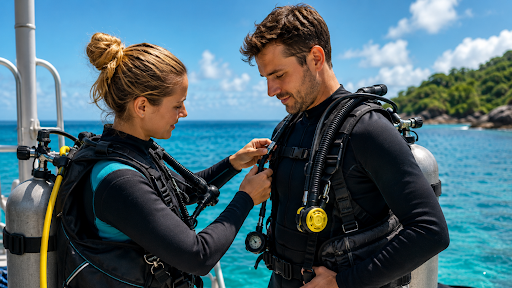
Imagine standing on the deck of a dive boat. The sun is shining, the water is a brilliant turquoise, and the reef below is calling your name. You are geared up, excited, and ready to giant-stride into the blue. But before your fins touch the water, there is one non-negotiable step that separates a safe, unforgettable dive from a potential underwater emergency: the dive buddy check.
Data from the Divers Alert Network (DAN) consistently reveals a sobering truth—roughly half of all scuba diving accidents could be entirely prevented before anyone even steps into the water. Despite this, a dangerous trend known as the “experienced diver trap” plagues the dive community. As divers gain experience, complacency creeps in. A thorough safety review is too often replaced by a casual glance and a quick, “You good?”
To combat this complacency and build a universal safety culture, training agencies rely on structured acronyms. The most famous of these is BWRAF. But what exactly does BWRAF scuba protocol stand for, and how do you execute it correctly?
Breaking Down the BWRAF Acronym
BWRAF is a chronological, step-by-step checklist designed to ensure that both you and your buddy are completely prepared to submerge. It is structured from the most complex life-support gear down to the final personal touches. Here is how to perform a proper check every single time.
B – BCD (Buoyancy Control Device)
Begin by checking your buddy’s BCD. Physically press the power inflator button to ensure air flows smoothly into the bladder, and then test the oral inflation valve. Don’t stop there—locate and pull the visual dump valves (usually on the right shoulder and lower rear) to confirm that air exhausts quickly. Finally, verify that the low-pressure inflator hose is securely connected to the BCD.
W – Weights
Weight systems vary drastically from diver to diver. Whether your buddy is using a traditional weight belt or integrated BCD weight pockets, you need to inspect them visually and physically. Ensure that weight belts are fitted with a clear right-hand quick-release buckle. If they are using integrated pockets, pull on them gently to verify they are locked into place, but ensure your buddy knows exactly how to ditch them in an emergency.
R – Releases
Now, examine all buckles, straps, and clips. Walk around your buddy to check the chest strap, waist cummerbund, and shoulder adjustments. Crucially, check the tank band at the back. Give the tank a firm downward nudge to ensure it won’t slip out mid-dive—a common and highly disruptive problem when nylon straps expand in the water.
A – Air
This is the most critical element of buddy check diving, and it is where most shortcuts happen. Do not just look at your buddy’s pressure gauge to see if the tank is full. Have your buddy put their primary regulator in their mouth and take three deep breaths while you watch the needle on their submersible pressure gauge (SPG). If the needle drops dramatically with each breath, the tank valve is either completely closed or only partially open. Finally, test the alternative air source (octopus) to ensure it breathes easily and is clean.
F – Final Check
Take a step back and look at your buddy from head to toe. Are their fins on securely? Is their mask strap straight and untwisted? Are all accessory hoses neatly streamlined to prevent them from dragging across delicate coral? Finish with a clear, visual “O.K.” hand signal.
Keeping It Memorable: Fun Mnemonics
Let’s face it: memorizing “BWRAF” can feel a bit dry. To keep safety lighthearted yet effective on a crowded boat, instructors have come up with dozens of creative sentences to remember the sequence.
Babies With Rashes Are Fussy
If that doesn’t stick, you can try some of these popular variations used across the globe:
- Breathing Water Really Ain’t Fun (A blunt reminder of why we check!)
- Bruce Wayne Regrets All Flippers
- Begin With Review And Friend
Beyond Training Agencies: The Principle Stays the Same
While BWRAF is one of the most widely recognized pre-dive safety check systems, the exact acronym can vary between training organizations. Divers trained through different agencies may learn slightly different sequences or memory aids, but the goal is always the same: ensuring that both divers and their equipment are fully prepared before entering the water.
As you progress into more advanced forms of diving, safety checks become even more detailed. Technical divers using side-mount configurations, twin sets, or closed-circuit rebreathers (CCRs) follow specialized pre-dive procedures designed for their equipment and environment. Regardless of the system used, the underlying philosophy never changes: verify your life-support equipment, confirm that everything is functioning correctly, and ensure your dive buddy can assist you if an issue arises underwater.
Take Action on the Boat
No matter how many logged dives you have under your belt, skipping the pre-dive safety routine is never a sign of expertise—it is a sign of complacency. Treat every single check with the respect your life deserves.