
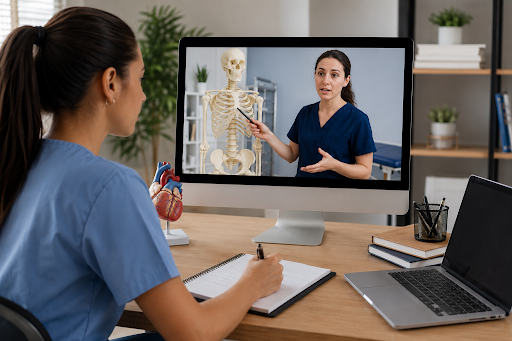
When most people research online medical assistant programs in Houston, they compare the same four things:
- Program length
- Total cost
- Schedule flexibility
- School reviews
Those are reasonable starting points. But there is one factor that almost never makes it onto the comparison list, and it is arguably the one that determines your outcome more than any other.
The instructor. The person standing behind the curriculum shapes everything from how well you absorb the material to how confidently you walk into your first externship shift. So, before you click that enrollment button, use this guide to separate strong online medical assistant programs in Houston from those that simply market themselves well.
Why Do Most Students Never Think to Ask About the Instructor?
It makes sense that cost and schedule dominate the research process. Those are the practical barriers that determine whether enrollment is even possible. But once you have confirmed that a MA program fits your budget and your calendar, the next question should be: who is actually going to teach me?
The reality is that most websites of online medical assistant programs in Houston don’t disclose instructor information. You will find plenty of detail about the curriculum modules, the certification the program prepares you for, and the flexible payment options. What you are less likely to find front and center is a genuine profile of the person delivering the instruction:
That gap exists for a reason. A strong, credentialed, experienced instructor is a competitive advantage, and MA programs that have one lead with it. If any school does not disclose this info, it may mean they do not have an experienced instructor and could jeopardize your learning.
What a Qualified Medical Assistant Instructor Actually Looks Like?
Not everyone with a healthcare background is equipped to teach. And not everyone with a teaching background is equipped to prepare medical assistant students for the realities of a Houston clinical environment. The ideal instructor sits at the intersection of both.
Here is what that combination looks like in practice:
- Do they have real clinical experience? An instructor who has worked as a healthcare professional, not just an educator. They bring something to the classroom that a purely academic background cannot replicate.
- Are they credentialed? Look for instructors who hold relevant certifications in
medical assisting, clinical practice, phlebotomy, EKG, or related fields. A credentialed instructor demonstrates the depth of their teaching. - Are the classes live and instructor-led, or self-paced recordings? This distinction matters significantly. Self-paced recorded modules can be useful as supplemental material, but a MA program built entirely around pre-recorded content offers no opportunity for real-time Q&A, direct feedback, or the mentorship that helps students actually internalize what they are learning.
The Difference Between Live Instruction and a Pre-Recorded Course
This distinction matters enormously, and it is one of the clearest ways to separate quality online medical assistant programs in Houston.
A pre-recorded course where you watch video modules on your own schedule with no live interaction has its uses as a supplemental resource. But as the primary delivery method for medical assistant training, it has significant limitations that most prospective students do not fully appreciate until they are already enrolled.
With pre-recorded content, these are the problems you may face:
- There is no opportunity to ask a question at the moment when a concept is not landing.
- There is no instructor observing how you are processing the material and adjusting their explanation accordingly.
- There is no accountability structure that mirrors the professional environment you are training to enter.
Live, instructor-led classes, even when conducted online, operate differently. You show up at a scheduled time. Your instructor is present. Demonstrations are interactive. The learning environment has the structure and accountability that clinical training actually requires.
For Houston students specifically, this matters because the facilities where you will do your externship and eventually work do not operate on a self-paced schedule. Showing up prepared, on time, and ready to perform is the baseline expectation. A MA program that trains you in that environment from day one is preparing you for the reality of the job. One that lets you click through modules at 2 a.m., whenever it’s convenient, is not.
Conclusion
CCI Training Center’s online medical assistant program in Houston is built around exactly the kind of instruction this guide describes. The MA program’s lead instructor is Dr. Nathaniel Pettigrew, whose background spans over 25 years in healthcare, 15 years of leadership in allied health education, and service as a U.S. Navy Hospital Corpsman.